Protecting Business

Flat Roofing

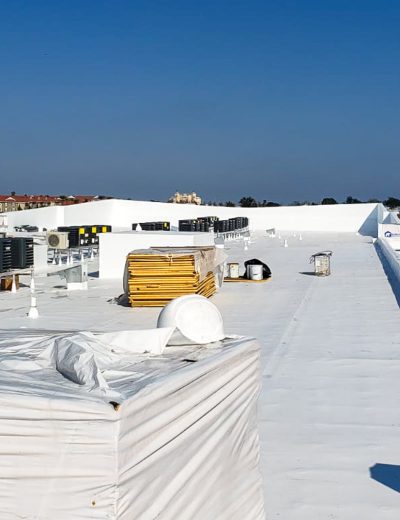
We deliver reliability and performance for residential, multi-family, apartment complexes and businesses buildings. Offering TPO (Thermoplastic Polyolefin) – a widely used single-ply membranes for flat roofing – along with modified bitumen (base and cap) and custom flat roofing systems.

Everth Roofing of America installs and services low-slope and steep-slope commercial roofing systems across Central Florida. From occupied retail centers to multifamily roofs and light industrial, our project managers coordinate scheduling, safety, and closeout documentation with minimal disruption to your tenants and operations.

Residential & Commercial Flat Roofing Applications

Single Ply TPO (Thermoplastic Polyolefin)

TPO is a single-ply, thermoplastic membrane with heat-welded seams. It’s popular on low-slope roofs for its reflective surface (energy savings in hot climates), fast installation, and wide availability of accessories. Performance is driven by membrane thickness, fastening patterns, insulation design, and edge metal—especially in Florida wind zones.

commercial tpo flat roofing services by everth roofing of america

Long Lasting Waterproofing Coverage

Provides a bright, reflective surface and heat-welded seams for reliable waterproofing on large low-slope roofs. Delivers strong value with broad accessory availability and competitive lifecycle cost in Central Florida climates.

Installed To Commercial Specifications

Performance depends on correct fastening, insulation, and edge metal to meet Florida wind requirements. Quality of welds and details varies by crew, so specification and field supervision directly affect outcomes.

Basic Protection Is Warranted

Harsh exhausts, grease and flying debris can risk TPO to damage or degrade faster than alternatives needing armored protection. Choose PVC or KEE-PVC for superior chemical resistance and longer service under environmental exposure.
Material Selection

Modified Bitumen (SBS/APP)

Modified bitumen combines asphalt with polymers to create multi-ply redundancy. Installed via torch, cold-adhesive, or self-adhered methods, it’s durable at details and resists punctures on smaller roofs with foot traffic.

Protective Armor

Multi-ply redundancy provides stout puncture resistance and durability on smaller roofs with frequent penetrations or foot traffic. Layered construction handles impacts well and delivers predictable performance across varied details.

Versatile Design Options

Heavier and more labor-intensive than single-ply systems, with install methods that require strict safety controls. Reflectivity depends on cap-sheet selection or post-applied coatings to meet most modern energy goals.

Tried & Trusted

If you prefer faster, cleaner installs with built-in reflectivity and welded seams, consider TPO or PVC. There's a reason you see this installation style both residentially and commercially.
petra.jpg

Frequently Ask Questions?

We look at UV exposure, foot traffic, chemical/grease exposure, wind conditions, and your budget/warranty goals. TPO is common for reflective efficiency, PVC for chemical resistance, and EPDM for flexibility and long-term durability.


Options strictly range from manufacturer material warranties to system/NDL (No Dollar Limit) warranties depending on substrate, assembly, and installation requirements. We’ll outline paths and prerequisites in your proposal, but always deliver a labor warranty with each installation.

TPO. White, reflective, heat-welded seams with broad availability. It’s the cost/performance baseline for large low-slope roofs that don’t see grease or harsh chemicals. Most of the time, if you're talking commercial roofing, you're discussing TPO.

This is definitely a conversation to be had in person, but 60 mil is the common starting point. 80+ mil if you want more durability/hail resistance or a longer warranty path. 45–50 mil is budget—expect shorter terms.

Both work well. In Florida wind zones, perimeter attachment and edge metal drive uplift performance. Mechanically attached is common; but fully adhered reduces flutter. Fully-adhered installations also save on labor while delivering spectacular protection and longevity, making it a consideration; however the material comes at a higher cost.

In The Real World

A Sneak Peak